The Restoration of Israel by Dr. Peter S. Ruckman
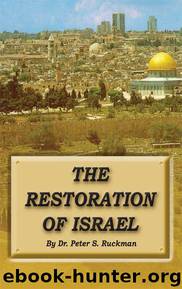
Author:Dr. Peter S. Ruckman [Ruckman, Dr. Peter S.]
Language: eng
Format: mobi, epub
Publisher: BB Bookstore
Published: 2011-06-08T04:00:00+00:00
The Attacker from the North
A careful study of Ezekiel 38 and 39 yields some rich Bible truths on the future of Palestine in God’s program. Not everyone agrees as to the times and settings of these events, but generally speaking, we can say that the battle of Gog and Magog, spoken of here, is either:
1. Just before the Rapture of the saints.
2. Just before the Millennium begins—Armageddon.
3. Just before the White Throne Judgment—at the end of the Millennium: Revelation 20:7–10.
There are several things clear in the study of these two chapters and then several things which are not so clear. It is clear that:
1. Palestine is the country at stake in that fighting (Ezek. 38:5–15, 39:1–11).
2. Palestine’s enemies come from the north (Ezek. 38:6, 9, 15, 39:1–11).
3. Palestine’s enemies are thoroughly defeated.
I would not be dogmatic in teaching on the battle of Ezekiel 38 and 39 for many good men (and believing men) disagree as to the time setting of this battle. There are at least three reasons why this battle could be the battle of Armageddon spoken of in the last verse of Revelation 19, and there are at least two reasons why it is probably the battle of Gog and Magog spoken of in Revelation 20, just preceding the White Throne Judgment. To better understand the difficulty here, notice, first, the ways in which the battle of Ezekiel 38–39 is different from the Gog and Magog of Revelation 20.
1. In Revelation 20:7–8, Satan is the leader; in Ezekiel 38:2, Gog is the leader.
2. In Revelation 20:8, the armies are from the four quarters of the earth; in Ezekiel 38:6, they are from “the north quarters.”
3. In Revelation 20:9–10, the termination of the battle goes directly into the destruction of the heavens and earth and the last judgment begins; in Ezekiel 39:11–17, there is a period of seven months of burying following the battle.
4. In Revelation 20:9, the attack is on Jerusalem, a city; in Ezekiel 38:8–13, the attack is on Palestine, a country.
These “differences” have led scholars to believe that the battle of Gog, in Ezekiel 38–39, must occur before the battle of Gog and Magog, mentioned in Revelation 20.
But on the other hand, notice the similarities between these passages of Scripture (Ezek. 38; Rev. 20).
1. The instrument of destruction in both cases is FIRE (Ezek. 38:22; Rev. 20:9).
2. The name Gog is prominent in both prophecies (Ezek. 38:2; Rev. 20:8–9).
3. Israel is “at rest” in both contests (Ezek. 38:8–11; Rev. 20:1–9).
Regardless of where one puts the battle of Ezekiel 38–39, there are several facts which are clear, and personally, I am inclined to believe that the Gog of Ezekiel 38–39 is an earlier “foretaste” of the last great battle of Gog and Magog, which will not take place till the end of the Millennium. You see there is something about the order of chapters in a King James Bible which would almost prove conclusively that the battle of Gog in Ezekiel 38–39 is a battle to take place before the Second Advent of Christ.
Download
The Restoration of Israel by Dr. Peter S. Ruckman.epub
This site does not store any files on its server. We only index and link to content provided by other sites. Please contact the content providers to delete copyright contents if any and email us, we'll remove relevant links or contents immediately.
The Secret Power of Speaking God's Word by Joyce Meyer(3161)
Signature in the Cell: DNA and the Evidence for Intelligent Design by Stephen C. Meyer(3123)
Real Sex by Lauren F. Winner(3005)
The Holy Spirit by Billy Graham(2938)
The Gnostic Gospels by Pagels Elaine(2517)
Jesus by Paul Johnson(2349)
Devil, The by Almond Philip C(2324)
23:27 by H. L. Roberts(2245)
The Nativity by Geza Vermes(2224)
Chosen by God by R. C. Sproul(2158)
All Things New by John Eldredge(2155)
Angels of God: The Bible, the Church and the Heavenly Hosts by Mike Aquilina(1951)
The Return of the Gods by Erich von Daniken(1925)
Angels by Billy Graham(1919)
Knowing God by J.I. Packer(1848)
Jesus of Nazareth by Joseph Ratzinger(1802)
The Gnostic Gospel of St. Thomas by Tau Malachi(1781)
Evidence of the Afterlife by Jeffrey Long(1775)
How To Be Born Again by Billy Graham(1775)
